

The Codex Amiatinus
Earliest surviving manuscript of the nearly complete Latin Vulgate Bible
75 lbs, 19.25"x13.375", and 7 inches thick
In 692, Ceolfrid commissioned 3 copies of this bible. The monastary got a land grant to raise 2,000 more heads of cattle to produce the vellum (Looks like nonprofits got grants even back then for project:) ). The project for all three was done by 716. That year Ceolfrid died while bringing a finished copy to Rome.
However I noticed there were some other cool images from that book so I decided to put that here. All the images on this page are from the Amiatinus unless otherwise noted.
Saint Paul's church, Jarrow is an excellent site on the Codex
 I love this page. Ezra, a prophet, is copying the "Books of the Law" and behind him you can see amarium filled with codices. It gives you an idea of how thick the codices were typically back then as they had to lay the books down rather than stand them up on their spine.To view it at 1475x2052, got to wikicommonsand click the image | Ceolfrid was the Abbot of Wearmouth-Jarrow Abbey. Each of the commissioned copies of the bible had more than 1,000 pages of vellum in them. Vellum isn't paper but rather is a translucent material made from the skin of cattle, camel, deer, pigs and other mammals. It is very durable and can last more than 1,000 years. Think of it as a very fine, translucent page of leather. Nowadays papers you find in art or paper stores that say they are vellum are not but rather are better quality papers made from cotton. Medieval manuscripts and paintings (until the 1500's and advent of canvas) were often done on vellum. So the 2,000 extra cattle that the Ceolfrid had the monastaries raise were for their skin -- but I hope they also enjoyed a feast |
| because back then there was no refrigeration and I'd hate to think of all that steak going to waste. |  Genesis 3:16 |
 Christ in Majesty at the start of the New Testament | Now when we talk about the bible being copied, seven monks who were scribes handcopyied each page in Latin calligraphy. Even back then, whole bibles weren't copied as usually a monastary was likely to just create a copy of the Book of Psalms or the Four Gospels. The seven scribes copied the Codex Grandior, a bible translated from hebrew into Italian by St. Jerome. This is known as the Vulgate Bible. There are a few Apocrypha books |
| in the Vulgate that is not in the King James version which is the one many people are most familiar with (you know the ones that almost every motel has in their rooms). The books in the Vulgate Bible not in the King James are Tobias, Judith, Wisdom, Baruch, 1 Macabees, 2 Macabees, and Sirach. The Internet Sacred Text Archive has a nice feature online so you can see the different texts by the different bibles if you're interested. |  Luke iv.32-v.6. |
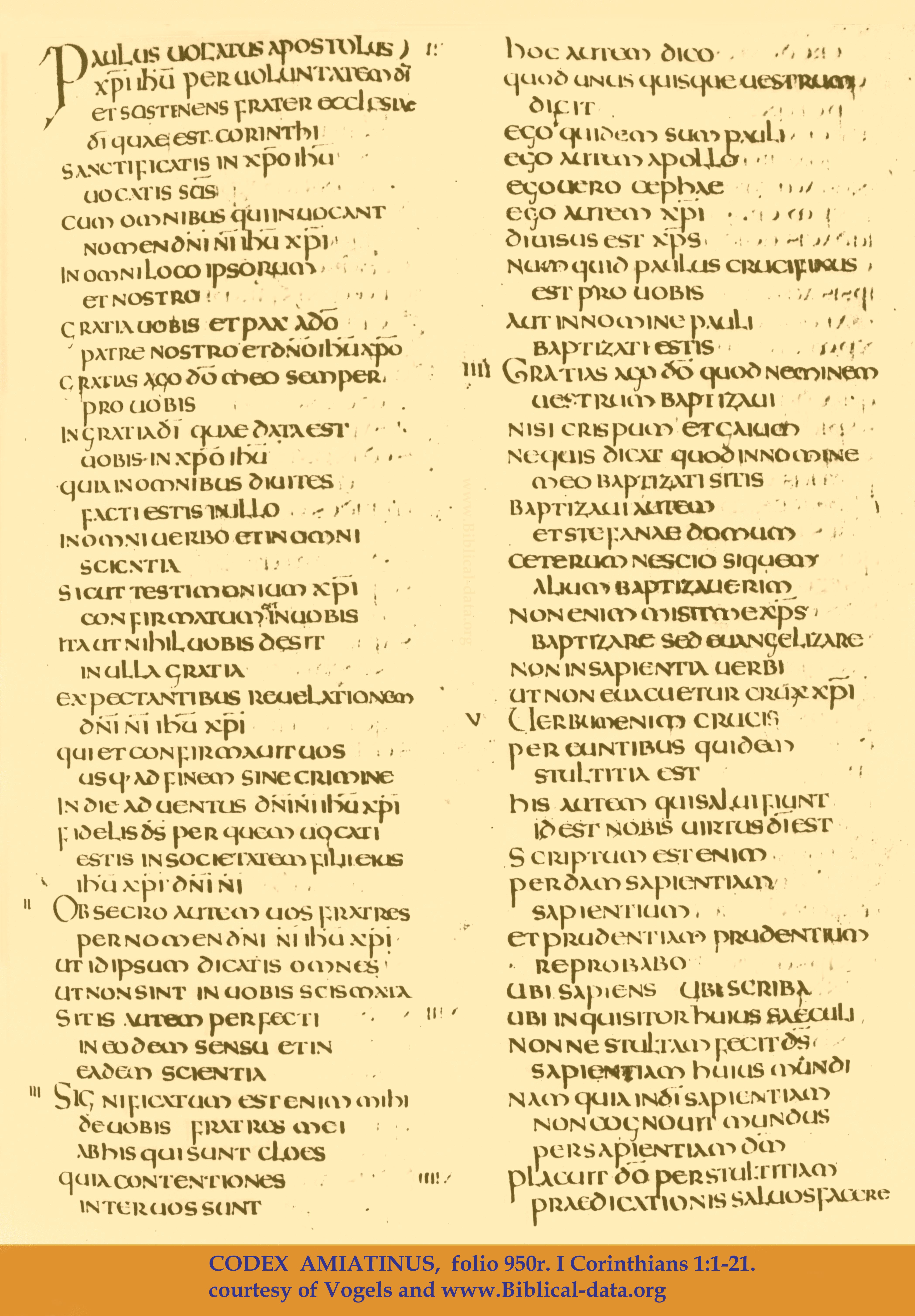 | The Codex Grandior was a 6th century codex that is now lost. Likewise, the two copies of the Amiatinus that the monastaries kept for themselves have disappeared. The third one that the now retired Abbot Ceolfrid at age 74 started taking to give to the Pope but he died on the journey at a Burgundy monastary. His companions presented the codex in his name. It is now in the Laurentian Library in Florence. |
Interestingly enough the Library did not know it had the Pope's Ceolfrid's bible for a 100 years because the dedication page had been altered. The librarians thought it was an earlier Vulgate bible copied by Servandus in 540AD. Ultraviolet light revealed Ceolfrid's name underneath the name of Peter of Lombard which revealed that it was the 716 text making the text more than 150 years younger but it is still the oldest remaining Vulgate bible unless another one is found. The library has unbound the original to make negatives of each page. The replicas are smaller than the original -- partly because a 75lb book takes a lot of room, not to mention a pain to carry from the shelf to the desk (of course, a CD-Rom is superlight. The La Meta Editore company describe the process of copying the original at http://www.lametaeditore.com/2ing.htm. I don't know why but the images their 2nd page which is on the binding don't load properly but you can see the binding process on the bookbinding page of the Julie of Norwich (a 14th century writer) website.
Resources
Codex Amiatinus
Art of Codex Amiatinus
 by Rupert Bruce-Mitford, 1967
Bede, Cassiodorus, and The Codex Amiatinus
 by Paul Meyvaert
Codex Amiatinus and the Byzantine Element in the Northumbrian Renaissance
 by Per Jonas Nordhagen, 1977
Codex Amiatinus of the Latin Vulgate Bible and Its Birthplace
 by H. J. White, 2006
Vulgate Bibles
GNT Catholic Bible (Vulgate)

The Holy Bible, Translated from The Latin Vulgate

Other
Scribes, Script, and Books
 by Leila Avrin, 2010. "This is an encyclopaedic history of the handmade book from antiquity to the Renaissance. It looks at the origins of the book, the development of scripts and styles of illumination, the making of manuscripts, and the technological processes involved." The Codex, of course, gets a mention
The Early Medieval Bible: Its Production, Decoration and Use
 The Early Medieval Bible: Its Production, Decoration and Use (Cambridge Studies in Palaeography and Codicology) by Richard Gameson, ed., 2009
Lives Of The First Five Abbots Of Wearmouth & Jarrow: Benedict, Ceolfrid, Eosterwine, Sigfrid, And Huetbert
 by Ernest Thompson Seton, 2008.
Life of Ceolfrid, Abbot of the Monastery at Wearmouth and Jarrow
 by D.S. Boutflower, 1991.
The Place of Wearmouth and Jarrow in Western Cultural History
 by J. D. A. Ogilvy, 1970.
Codices Illustres The World's Most Famous Illuminated Manuscripts 400-1600
 by Ingo F, and Norbert Wolf Walther, 2005
Fiction
Vellum
 by Matt Donovan. It's poetry. I haven't read it but it got five stars on Amazon so I thought I'd add it.


 "In this reconstruction, the doors from the Museum lead to storage rooms for the Library (of Alexandria). Most of the books were probably stored in armaria, closed, labeled cupboards that were still used for book storage in medieval times."
 . Harry Ransom Humanities Research Center, 2004.
 by Janet Ing Freeman. CD-ROM. Octavo, 2003. [note from me: if you have never seen an Octavo CD, they are amazing. This CD holds 1971 pages. This is a scan of every page of an original Gutenberg Bible on vellum printed in 1455 which is 1,286 pages (one of the three perfect copies that survived owned by the Library of Congress (LOC): the LOC paid $1.5 million for it in 1930. This copy was first owned by Benedictine monks who threw it out the window of their burning monastery in 1768 during the French Revolution. They took it to Switzerland in a journey through several countries, it came to rest at the LOC ). They also include a translation of the text into English. Anyways as you can see I love the Octavo CDs).
 by Lindsey Davis, Minotaur Books, 2009. A first century Roman, Marcus Didius Falco, investigates the murder of the Alexandria librarian.
 : A Novel by Blake Morrison. Harper Perennial, 2003. Fictional biography.
 , glory of the Hellenic world;: Its rise, antiquities, and destruction by Edward Parsons. London, 1952.
 by Frederic P. Miller, Agnes F. Vandome, and John McBrewster. Alphascript Publishing, 2009.
 (chapter: "The Return of the Vanished Library"). Alexander Stille. New York: Farrar, Straus and Giroux, 2002. 246-273.
 by John Marlowe. Trinity Press. London: 1971.
 : Towards the history of a symbol by Jon Thiem. Journal of the History of Ideas, Inc., 1979.
 by Edward Gibbon(chapter: "Destruction of Paganism", "The temple of Serapis at Alexandria" and "Its final destruction, A.D. 389" subchapters)
 by Harris, Michael H. 4th ed. Metuchen, N.J: Scarecrow Press, 1995.
 by Emer D. Johnson. Scarecrow Press, Inc. Metuchen: 1970.
 (Wisconsin Studies in Classics) by Rudolf Blum. University of Wisconsin Press, 1991.
 by Lionel Casson (Yale: Yale University Press, 2001) esp. Chapter 3
 by Matthew Battles, W.W. Norton & Co., 2004.
 , Revised Edition, by Roy MacLeod, I. B. Tauris, 2004.
 by El-Abbadi, Mostafa (1992). Paris: UNESCO, 2nd edition. ISBN 9231026321.
 by Tolzmann, Don Heinrich, Alfred Hessel and Reuben Peiss. (New Castle, DE: Oak Knoll Press, 2001.
 (trans. Roy J. Deferrari) (1964). Washington, D.C.: Catholic University of America.
 (Volume 1) by Derek Flower, CreateSpace, 2009.
 by Luciano Canfora and M. Ryle (California: University of California Press, 1990)
 (Library of the Written Word) by Mostafa El-Abbadi, Omnia Mounir Fathallah, and Ismail Serageldin, Brill Academic Publishers; illustrated edition edition, 2008.
 by Stephan Fussel and Douglas Martin. Ashgate Publishing, 2005.
 , by Laurence Elliott Tomlinson. Judd & Detweiler, Inc, 1938.
 by John Man. Wiley, 2002.
 by Martin Davies. Pomegranate, 1997.
 . 2 volumes. by Editor Jean-Marie Dodu. Editions Les Incunables, 1985.
 : a historical study by Janet Ing. The Typophiles, 1988
 by Albert Kapr and Douglas Martin. Ashgate Publishing; 3rd edition, 1996.
 by Ralph Willett. BiblioBazaar, 2009.